Upcoming Classes:
Northern Lights Yoga - Class Cancellations Extended In order to protect the health of our students, we have extended the cancellation of classes through at least the end of the year. We'll keep watching news from the CDC, WHO, and the governor's office and let you know once we are ready to reopen.
Northern Lights Yoga
We have been serving the Northern Rockies with a large variety of weekly
classes and many weekend and week-long workshops for over twenty-six years.
With over eighty years of combined Iyengar Yoga teaching experience, our
most important gift is the high quality of our teaching and the large variety
of classes that we offer.
What is Yoga?
The word ‘Yoga’ is often translated as ‘Union’ or, more fully, as ‘the union of body, mind, & soul’. In the Yoga Sutras of Patanjali (the basic and ancient text of Yoga), Yoga is translated as ‘the cessation of the fluctuations of consciousness.' Yoga has eight limbs or aspects: Yama (moral), Niyama (social), Asana (tuning the body and the mind through the practical application in the poses), Pranayama (control of the subtle energies through the use of the breath), Pratyahara (relaxation and internalization of the senses), Dharana (concentration), Dhyana (meditation) and Samadhi (the ultimate state of self-realization). These are collectively known as Ashtanga Yoga (eight limbs or aspects of Yoga).
Of these, the first five can be taught; the remaining three are attained through sincere practice of the others. Yoga is not a religion. Yet, its practices and precepts can fit with any religion. Most people are introduced to Yoga through the practice of Asanas or poses. The word ‘Asana’ can be translated as ‘to bring together the body and mind to form a quiet comfortable seat from which to observe the soul’.
What is Iyengar Yoga?
Yogacharya (Master Teacher of Yoga) B.K.S. Iyengar is a foremost authority on the subject of Yoga. He has made it possible for ordinary humans from all walks of life to experience the practice of Yoga and the wisdom of the Yoga Sutras. He has done so through teaching the practical application of these teachings.
He finds the meaning of the Yoga Sutras by practical search and regular practice, experimenting on himself before sharing his experiential knowledge amongst his students.
Yogacharya Iyengar has shown and taught how all the aspects of Ashtanga Yoga are integrated in the practice of Asana and Pranayama; how practicing the asanas and the pranayamas teaches a man to concentrate on any subject; how a man can develop his discriminative faculty to attain physical poise and mental peace, intellectual clarity and emotional equanimity. Thus, by the practice of Yoga, one can become better at all they choose to do.
His style of teaching which is now being followed by teachers trained by him (along with his daughter Geeta and son Prashant) has led to it being called ‘Iyengar Yoga’.
The unique features of Iyengar Yoga are:
- It is meant for people of all ages, both genders, and cuts across geographical, lingual, social and economic barriers;
- The importance given to the practice of the standing asanas;
- The emphasis given to precision and alignment in all postures;
- The use of props as both a restorative/recuperative method and to deepen the
practice of the asanas
Congratulations
Congratulations to Erin Burke Webster who passed her Iyengar Yoga Intermediate I certification in October. We are so proud of you Erin. A little while back their were just the two of us CIYTs in Montana, now there are nine!
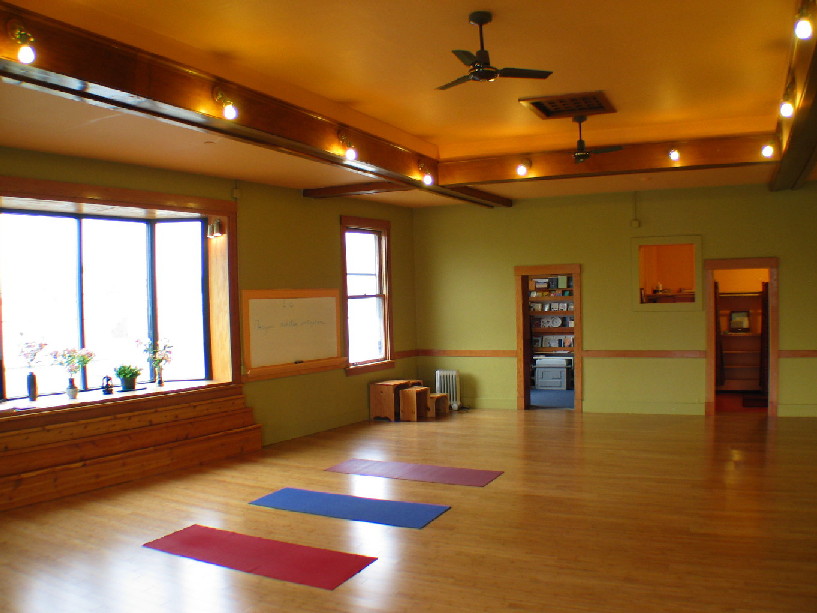
Click this image to see our space
Image by MontanaPictures.Net
